It's been hard to write about things that are personal when
all around you things are changing faster than you can keep up with, and the
discourse about what is happening is so involving and intriguing...though also,
of course, boring. But I have to remember, the personal
is still also political. And more importantly local. Very local sometimes...
I recently returned from a trip
to Canada and the US; I was alone on a strange continent! Fear and elation tipped in the balance, but I was left with a feeling of thankfulness; a very American feeling, judging from what they so often say (how to understand the emotions of people who talk about their emotions so often?), but also just a human one.
But coming back to Berlin, I was
also thankful. For the freedoms we have here, for the lack of drama, and
surprisingly, most of all for "the green" as the Germans would say.
German is good at that; keeping things simple by turning an adjective, grün, into a noun, das Grüne. Green spaces, leafy places, trees, grass, lakes...even
parks. It's not always complimentary, though; Leben
im Grünen is also a commercial phrase designed to attract home-owners and
investors to buy houses out in the sticks, and so it can be used with irony,
even disapproval by those hard-core city-dwellers in Neukölln or Kreuzberg when we tell them where we live.
But it's true. We do live in the
green. Birches and sycamores, now a darker, deeper and dustier green than when
I left their spring-like brilliance four weeks ago, surround our flat; the view
beyond the houses recedes into the green distance of the Berlin Forest with its
canals and rivers, and eventually, out to Wannsee. The plants on our balcony
(sage, honeysuckle, thyme, coriander, mint, box...) have sprung into lush,
bright green life, especially after the storms, floods and sunshine of the past week;
my morning commute by bicycle to the S-Bahn at Schlachtensee takes me through
airy green corridors of beeches, birches, firs and oaks, along green fields
(now yellowing in the heat) grazed by large, composed-looking white cattle and
small, over-excitable white sheep. Before getting the train, I
run down to the water for a quick swim; moving out to the centre of the lake,
the sun on my face, I turn on my back and am surrounded by a circle of bright
green trees and dark green water, the bowl of blue sky overhead mirroring the
bowl of green lake below, both full of life, seen and unseen.
At my conference in the US, I attended a seminar called "On Beauty". People are pretty consistent about what they find beautiful, and I'm no exception (the sea, the sky, lakes, trees, mountains, the Fernsehturm...). But finding beauty and finding things beautiful are
two different things. Finding beauty is not always easy. Beauty can't be separated
from whether you are able to access it; how lucky you can be, or not, to have it
offered, withheld or simply never seen as even important.
And this brings me back to
Berlin. In fact, to East Berlin, which is not, one has to admit, a place one
would instantly think of as beautiful. But Berlin offers its citizens beauty (as well as
ugliness) in many forms, and though not all of them sound beautiful to start
with, the fact that nearly anyone can access them makes them beautiful in a
special kind of way.
As if to prove this, last weekend we found beauty in a particularly strange place. Looking
through our book of 111 Things Not to
Miss in Berlin (highly recommended), I suddenly noticed something.
"Mel! There's a miniature railway! In the Wuhlheide!" No sooner said
than Googled: "And today they're having – OMG, there's a steam
special." It took a surprisingly short time for us to pack our bags and a
picnic and get on our bikes before catching the self-important, indispensable S7
train line all the way across town to Ostkreuz, where we threw ourselves onto its
unimportant, obscure cousin, the tiny S3 with just two carriages full of
holidaymakers, teenagers with fizzy drinks, disapprovingly tutting elderly
people("Tuh! Irresponsible cyclists!") and small children with
already exhausted parents. It was only midday, but already it felt like an
adventure, as we were carried out of the familiar surroundings of
Friedrichshain and Treptow out east to Rummelsburg, Köpenick and eventually the
"Wuhlheide", the Wuhl Heath.
I had never stopped here before.
My previous experience of the Wuhlheide had consisted mostly of avoiding it, as
a friend and I cycled, heady with the romance of a Berlin summer, to the
vastness of Müggelsee, on a hot, hot Sunday with nowhere to stop and rest until
we got there. That was seventeen years ago and there was no European Bike Trail
then, just the rushing road and endless cars, lorries and dust. We thought of
the Wuhlheide as a place for East German families to listen to Schlager while drinking beer and eating
Wurst in improbable quantities; after all, it was called a People's Park, Volkspark (anything with the prefix "Volks-" is best
avoided in the view of many younger Germans). We imagined it as a naff, yet
also intimidating place full of neonazis and Goths intent on hunting each other
down, with us, helpless intellectuals, caught in the middle, possibly under the
ironic gaze of brightly-coloured plastic Volksgnomes.
 |
| Heading into the heath |
But now, seeing it this time, I
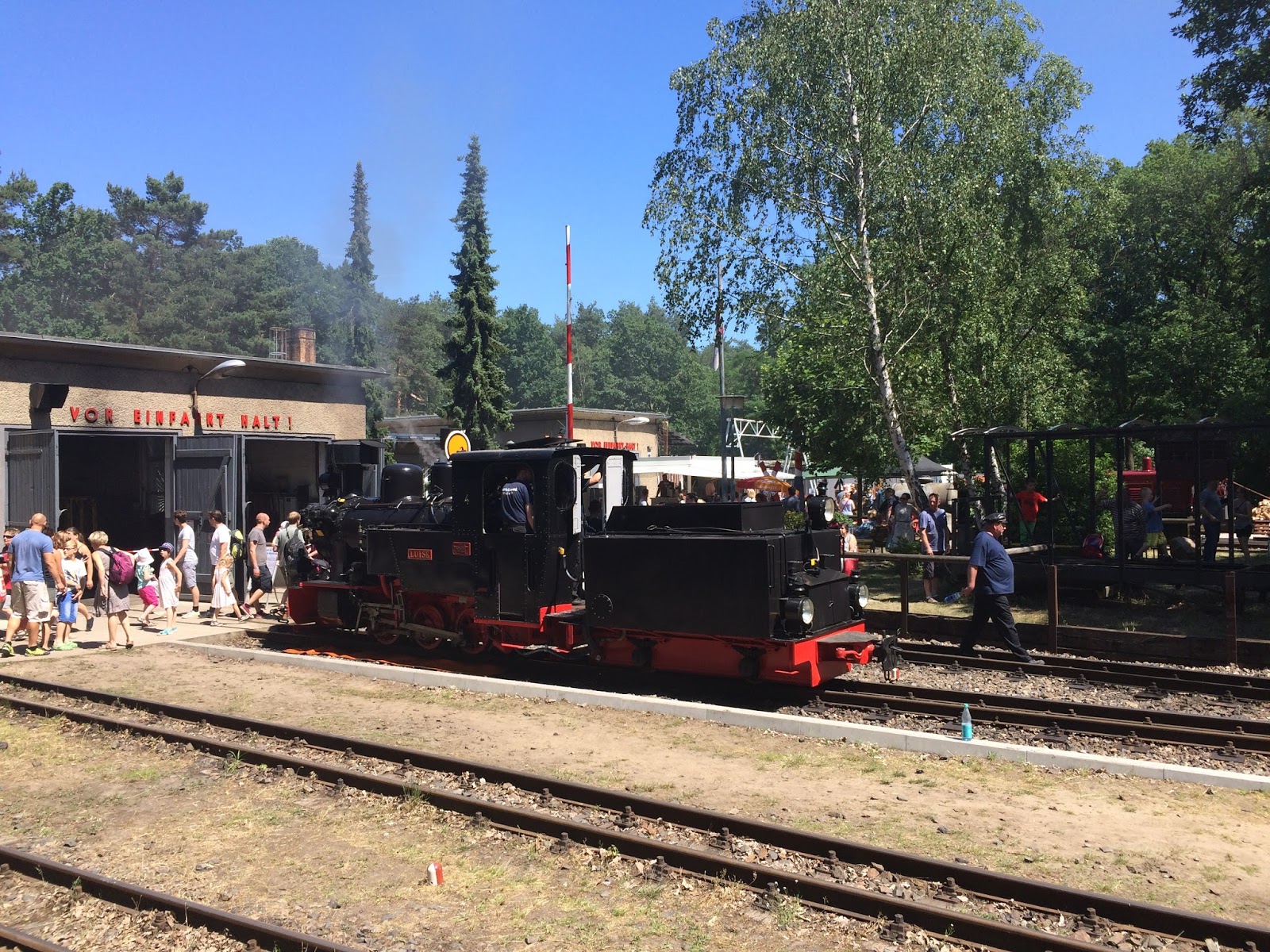
was unironically enchanted. No gnomes were visible. Instead, as we arrived at
the platform, stumbling out with our bikes, we suddenly stopped at the sound of
a loud whistle. Then there was the hiss of a steam engine, and there was the
engine itself, a tiny black smoking monster shining in the glare of the midday
sun, with wooden carriages full of people in the back. And to our amazement,
they were both smiling and waving; we've never before seen Germans wave
from public transport, unlike the British, who seem to take any opportunity to
do so. We waved back as enthusiastically as we dared.
Here, however, the similarity to British miniature railways ended. The railway at the
Wuhlheide, which opened in 1956, has a special history. It was a Pioniereisenbahn,
one of many narrow gauge railways in the Eastern Bloc designed for young
railway "pioneers" to prepare for their adult life as proud servants of the people (the Volk - a word which, I suddenly realise, here has an altogether different implication to what I'd assumed). Here, the East German railway company
– the Deutsche Reichsbahn – trained children and young adults as drivers, stokers, ticket
collectors and guards. And if that sounds unlikely, how about this - the Wuhlheide, then known
as the Pionierrepublik Ernst Thälmann, also contained a training centre for
young astronauts.
 |
| Where's the driver? Our train, the Luise |
But although the Parkeisenbahn
(park railway), as it is now known, is still partly run by children and young
people, its ethos and ownership has changed. After the fall of the Wall, as agreements were made, often controversially and painfully, between industries in East and West, the
Reichsbahn no longer wanted to pay for upkeep of the railway. Instead, a
charitable trust was formed; and, realising that nostalgia for steam is not
just a British invention, it had the brilliant idea of using steam engines alongside
the diesel ones that the DR had employed, gifted to the Wuhlheide by
other German miniature railways. Now the locomotives come from as far away as
Indonesia and Poland; the Indonesian engine, Merapi, though built
in 1925 in Hanover, was used on a sugar plantation in Java before
returning to Germany.

But one part of the DDR ethos
was not lost. The trust held onto the policy of encouraging children to run the
railways – forget Scouting, become a train driver! And we soon saw the results
for ourselves. After a bicycle ride through what seemed like endless
woodland and heath, getting lost as we followed the confusing sounds of the trains, we finally managed to find
the Hauptbahnhof, the main station. And here we saw the railway in its full
glory. Young boys, from the age of about 8 or 9 up, and young men checked our
tickets, manned the signals, and shouted obscure messages up to the train drivers,
who have to be 18 or over. No girls appeared to be involved, although they are
apparently welcome. But a girl sold us our tickets, and for just 6 euros
each, we got to climb on to the wooden carriages, sit in the sun and look out
at the woods and at other enthusiastic passers-by, holding up their small
children to wave – yes, really! – as we travelled the whole 7 kilometres of the
railways. The Chinese man in front of us and laughed with his toddler son.
Trainspotters took pictures. Mums and dads let their children lean dangerously
out of the wooden carriages for a better look at the engine up front.
 |
| Health and safety... |
"This could never happen in
the UK!" Mel shook her head. "This is amazing. Look at us, just a thin metal chain between us and falling out of the train, and a whole train
journey for just 6 euros. And everyone is so happy! And safe."
We later found out it had not
always been so safe; a child abuse scandal spoilt the reputation of the railway
for a while in the 1990s. Thereafter, social workers and teachers were brought
in and the policies sharpened up; recruitment and management was changed. But
the main principle did not change; children are still judged sensible and clever enough
to run railways. And they do.
We marvelled at the space children
and adults have out here to be themselves and to enjoy things outdoors without
any worry or interference. We marvelled at the huge size of the park, which,
once past the parts designed for entertainment (beer stalls, children's pools,
etc) revealed itself to be as much of a true heath as in East Anglia or Yorkshire, a vast
space where birds and insects can live alongside people. And we marvelled at
how unexpectedly beautiful it was; despite the Schlager at the beer stall, or
perhaps also because of them.
This spaciousness, the living in the green, is a gift; whatever your politics, whatever your income, you can find it, reach it, and be in it. You do not have to be rich or privileged, or own a car, as in America. This is a beauty that Berlin gives to us all for the price of an S-Bahn ticket, or as we found out on the way back along the Radweg (European R1), for a ferry ticket on Berlin's shortest ferry journey across the Spree; two minutes on the F11 for the price of a Kurzstrecke ticket. Swallows dipped around us and fish swam beneath. Something not just for the whole family, but for the whole Volk - whoever that now is, in Berlin, wherever we are from - to enjoy.
 |
| On the ferry |


 But it
is surprisingly quiet. When I went there first, on my own, a couple of months
back, there was hardly anyone about. The noise of the city seemed to suddenly dim as I made my way through the gates and up the sandy paths towards the little cafe. A large black cat with stripy paws
like monochrome socks was licking its paws casually in the middle of the path. A Berlin-chic, middle-aged
couple with leather jackets and bleached hair argued quietly over coffee before continuing their argument amongst the gravestones, but they turned out to be the people who look after the graves (obviously
even the volunteers are glamorous). Some Japanese tourists with black umbrellas clutched coffee as they stood uncertainly by some of the more imposing graves. All these people, and the cat, kept
disappearing and reappearing out of the little paths as I wandered slowly from
place to place absorbing the strangeness and quiet of it all, as if the cemetery liked to keep its visitors to itself; they seemed a long way away. It felt as though
a thirst I didn't know I had was being slaked; a thirst for stillness,
continuity, a sense of the past, a sense that people's bodies are still connected
to the earth and the trees, even in this most disconnected of cities.
But it
is surprisingly quiet. When I went there first, on my own, a couple of months
back, there was hardly anyone about. The noise of the city seemed to suddenly dim as I made my way through the gates and up the sandy paths towards the little cafe. A large black cat with stripy paws
like monochrome socks was licking its paws casually in the middle of the path. A Berlin-chic, middle-aged
couple with leather jackets and bleached hair argued quietly over coffee before continuing their argument amongst the gravestones, but they turned out to be the people who look after the graves (obviously
even the volunteers are glamorous). Some Japanese tourists with black umbrellas clutched coffee as they stood uncertainly by some of the more imposing graves. All these people, and the cat, kept
disappearing and reappearing out of the little paths as I wandered slowly from
place to place absorbing the strangeness and quiet of it all, as if the cemetery liked to keep its visitors to itself; they seemed a long way away. It felt as though
a thirst I didn't know I had was being slaked; a thirst for stillness,
continuity, a sense of the past, a sense that people's bodies are still connected
to the earth and the trees, even in this most disconnected of cities.

 But there's also an oddly futuristic element to it. Again like the Tardis, the strange simultaneity of history is conspicuous, bringing you smack bang up against the odd nature of past and future everywhere. Towards
the back of the cemetery is a wall commemorating the family of the Austrian
Ambassador in the nineteenth century; he and his wife are buried there with their
five French-sounding daughters, who all predeceased them in the space of months. Yet, the wall is also marked with the scars of
shells fired in the last days of the Second World War. Just along the way, a
delicate pillar marks Schinkel´s tomb, surprisingly modest, recalling for us an elegant, enlightened Berlin. But his life overlapped with the industrial revolution right here on this street. Johann Borsig, buried a few yards away, built one of Berlin's first factories on the corner of Chausseestrasse itself, shortly before Schinkel's death, and evidently enjoyed bombast;
in a disconcerting homage to Schinkel, Borsig's tomb is designed like a miniature opera house, complete with a miniature copy of
Schinkel's design for The Magic Flute decorating the interior of its dome. It also has a touchingly large stone plate commemorating his wife: a Prussian, not
overly elegant matron in stone, surrounded by cherubs.
But there's also an oddly futuristic element to it. Again like the Tardis, the strange simultaneity of history is conspicuous, bringing you smack bang up against the odd nature of past and future everywhere. Towards
the back of the cemetery is a wall commemorating the family of the Austrian
Ambassador in the nineteenth century; he and his wife are buried there with their
five French-sounding daughters, who all predeceased them in the space of months. Yet, the wall is also marked with the scars of
shells fired in the last days of the Second World War. Just along the way, a
delicate pillar marks Schinkel´s tomb, surprisingly modest, recalling for us an elegant, enlightened Berlin. But his life overlapped with the industrial revolution right here on this street. Johann Borsig, buried a few yards away, built one of Berlin's first factories on the corner of Chausseestrasse itself, shortly before Schinkel's death, and evidently enjoyed bombast;
in a disconcerting homage to Schinkel, Borsig's tomb is designed like a miniature opera house, complete with a miniature copy of
Schinkel's design for The Magic Flute decorating the interior of its dome. It also has a touchingly large stone plate commemorating his wife: a Prussian, not
overly elegant matron in stone, surrounded by cherubs.